

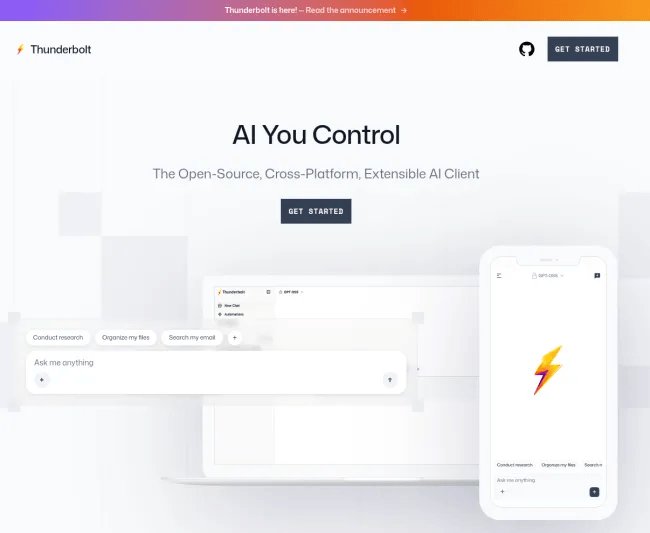
Mozilla has entered the enterprise AI race with the launch of Thunderbolt, an open‑source AI client built to run entirely on a company’s own infrastructure. The tool gives organizations more control over their AI stacks, letting them avoid relying on big‑cloud providers such as Microsoft Copilot or ChatGPT Enterprise.
What Is Mozilla Thunderbolt?
Thunderbolt is an open‑source, self‑hostable AI client developed by MZLA Technologies, the Mozilla‑backed subsidiary best known for managing the Thunderbird email client.
It is positioned as a “sovereign AI” client that can be deployed on-prem, in air‑gapped environments, or on sovereign clouds, keeping data and workflows under internal control rather than routed through third‑party cloud vendors.
Unlike many hosted AI assistants, Thunderbolt acts as a front‑end workspace that connects to whatever language models and automation backends an organization already uses.
How Thunderbolt Works
Thunderbolt hooks into deepset’s Haystack framework, an open‑source orchestration layer for AI pipelines, retrieval‑augmented generation (RAG), and agentic workflows.
It can connect to:
- Local or on‑prem LLMs
- Open‑source foundation models
- Commercial cloud endpoints (via OpenAI‑style APIs)
- Agent Client Protocol (ACP) and Model Context Protocol (MCP)‑compatible services
This lets enterprises mix and match models while keeping the core interface controlled internally.
Thunderbolt also supports an offline SQLite database as a local “source of truth,” enabling AI‑driven search and automation without constantly sending queries to external services.
Key Features for Enterprises
Thunderbolt is designed around chat, search, research, and automation, functioning as a unified AI workspace for teams. Main capabilities include:
- Model‑agnostic interface: Choose any model—local, open‑source, or commercial—behind the same UI.
- On‑prem and air‑gapped support: Run the client on single machines or full enterprise infrastructure.
- Enterprise data integration: Connect to internal data sources and APIs using open protocols.
- Security controls: Optional end‑to‑end encryption and device‑level access management.
Mozilla pitches Thunderbolt as a privacy‑first alternative to Microsoft Copilot, ChatGPT Enterprise, and Claude Enterprise, especially for regulated sectors like finance, healthcare, and government.
Cross‑Platform Availability and Licensing
Thunderbolt ships as a cross‑platform client with native apps for:
- Windows, macOS, and Linux desktops
- iOS and Android mobile devices
- Web‑based interface
The React‑based codebase is available on GitHub under the Mozilla Public License 2.0 (MPL‑2.0), making it easy to audit, modify, and self‑host.
For enterprises, MZLA offers paid licensing and on‑site deployment options, although the project is still in active development and undergoing security audits.
Why This Matters for the AI Ecosystem
Mozilla frames Thunderbolt as part of a broader push toward a decentralized, open‑source AI ecosystem.
MZLA CEO Ryan Sipes has compared the initiative to Firefox challenging Internet Explorer’s dominance, arguing that AI workflows are too strategic to be outsourced to a handful of proprietary cloud platforms.
By giving organizations a self‑hosted AI client that can tap into commercial, open‑source, and local models, Thunderbolt aims to give teams more choice, control, and long‑term sovereignty over how AI is used inside their stack.